 Photo by DVA Nguyen
Each year, around one new case per 10,000 inhabitants in Europe is infected by cholesteatoma. It is a serious form of chronic otitis presented as an abnormal proliferation of epidermal tissue, with desquamation and destruction of surrounding bones. As a consequence, complications can be dizziness, meningitis (or other brain infections), facial palsy or total and irreversible deafnes. The only current treatment is to remove the infected tissues through a surgical operation. However, the associated risk of recurrences due to residual cholesteatoma can reach 23-25% of cases depending on the country and age group. Follow-up strategy is systematically applied and induces a painful second examination of the patient, along with additional costs. The complete removal of cholesteatoma is thus a considerable limitation of current practices due to the limited dexterity of the surgical tools working in the tiny and confined space of the middle ear cavity.
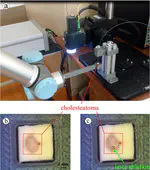
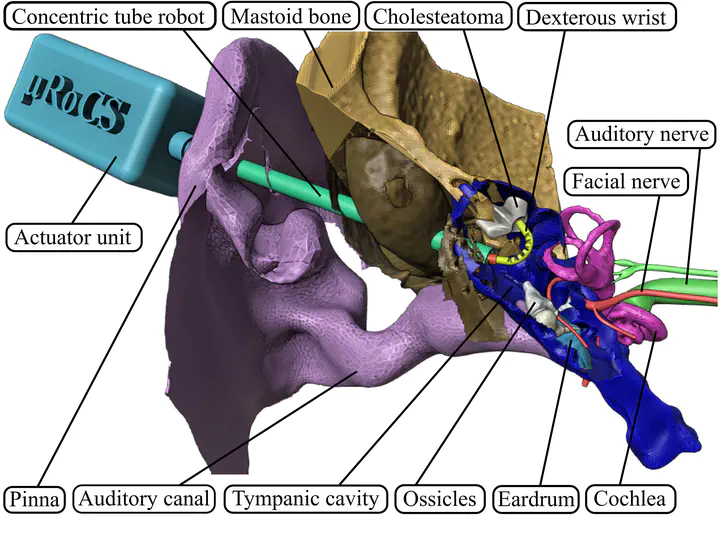
Therefore, the µRoCS project proposed a surgical robotic system including flexible microrobots which enable contact with hard-to-reach anatomical targets inside the middle ear and perform the cholesteatoma removal by laser. The aim of this project is to reduce the cholesteatoma recurrence by removing efficiently all infected cells from the first operation with a minimally invasive surgery. This microrobotic system will improve the accuracy and repeatability of the surgeon’s gestures. The accurate detection of cholesteatoma cells is supported by using optical biopsies. Thanks to a millimeter size and a high bending curvature of its distal end, the flexible surgical tool would improve the accessibility and minimize the need for large incisions.
This project is funded by ANR (Agence Nationale de la Recherche) with the partners including CHRUB (Centre Hospitalier Régional Universitaire de Besançon), INSERM (Institut National de la Santé et de la Recherche Médicale), FEMTO-ST (Franche-Comté Électronique Mécanique Thermique et Optique - Sciences et Technologies), and ISIR (Institut des Systèmes Intelligents et de Robotique). The project coordinator is Professor Laurent Tavernier, head of ENT Service at CHRUB.
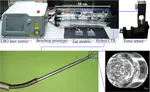
As member of the µRoCS project, the work of Mr. Nguyen focuses on the mechatronics discipline of the proposed hybrid continuum robot for middle ear surgery. The main contributions including the specifications, design, modelling, prototype fabrication and low-level control of the proposed microrobot based on anatomic constraints.

Dang-Viet-Anh Nguyen
PhD, R&D Engineer
My research interests include robotics, smart systems, and devices.