Abstract
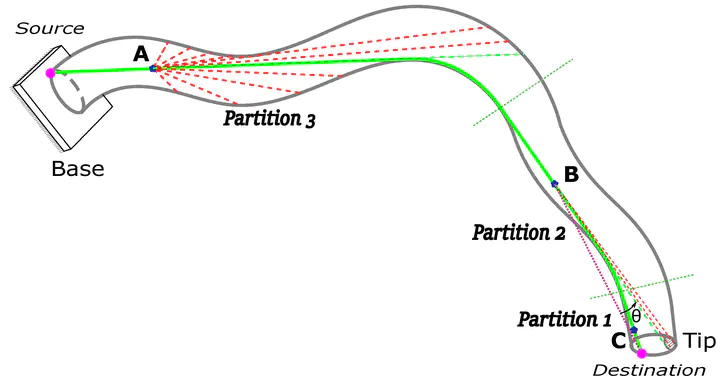
We propose a novel algorithm to determine the Euclidean shortest path (ESP) from a given point (source) to another point (destination) inside a tubular space. The method is based on the observation data of a virtual particle (VP) assumed to move along this path. In the first step, the geometric properties of the shortest path inside the considered space are presented and proven. Utilizing these properties, the desired ESP can be segmented into three partitions depending on the visibility of the VP. Our algorithm will check which partition the VP belongs to and calculate the correct direction of its movement, and thus the shortest path will be traced. The proposed method is then compared to Dijkstra’s algorithm, considering different types of tubular spaces. In all cases, the solution provided by the proposed algorithm is smoother, shorter, and has a higher accuracy with a faster calculation speed than that obtained by Dijkstra’s method.
Supplementary notes can be added here, including code, math, and images.

Dang-Viet-Anh Nguyen
PhD, R&D Engineer
My research interests include robotics, smart systems, and devices.